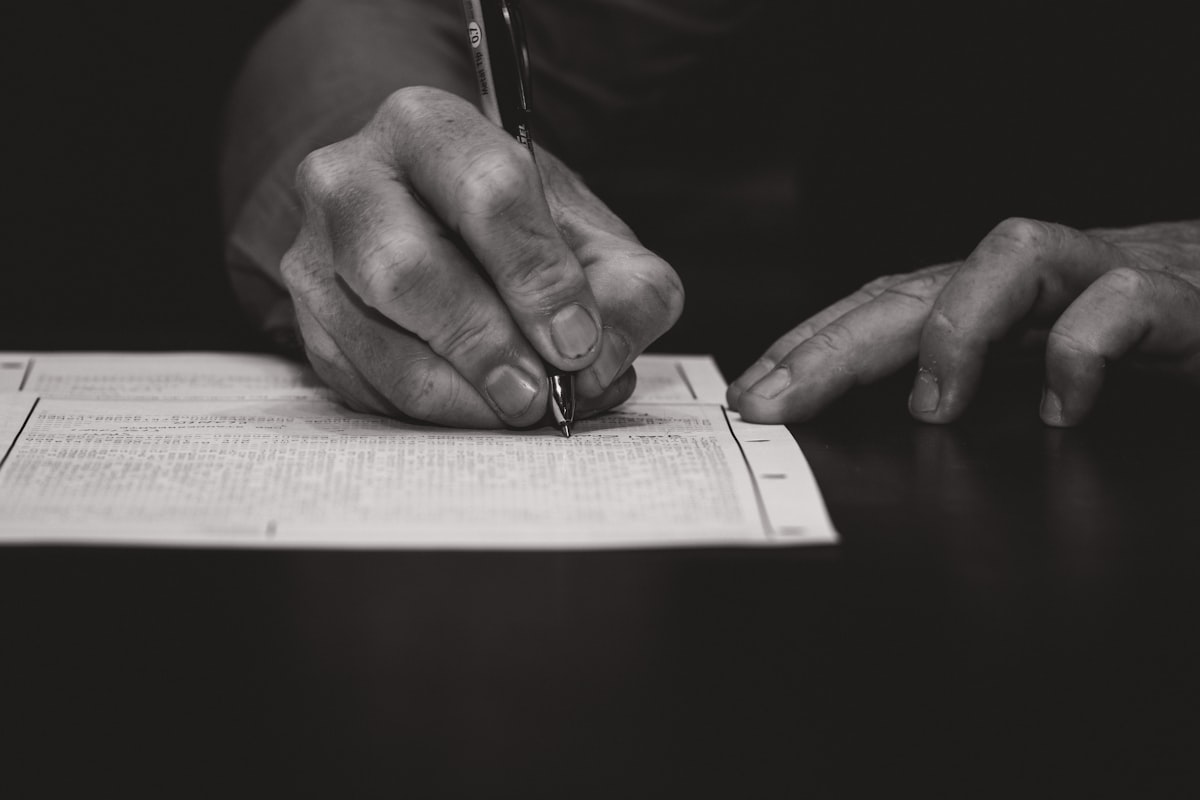
The content of the contract is often the main focus, but formal requirements are frequently addressed at the last minute, and it is precisely there that errors arise which later complicate proof. Who actually signed the contract, when this happened, and how many copies exist can determine in a future dispute whether the agreement can be proven at all.
Who signs the contract
The signature should belong to the person authorised to act on behalf of that party. For an individual, this is straightforward: the person concerned by the contract signs it. For a company, you must verify who is authorised to represent it: typically the managing director or a person holding a valid power of attorney. If a representative signs, it is sensible to request proof of their authority and file it together with the contract. Without this, it is difficult in any potential dispute to prove that the document actually binds the company.
Why the date matters
The date of contract conclusion determines when the agreed terms take effect and the order in which any amendments were created. Always state the date on which both parties actually sign: not the date the text was prepared, if different. If the parties sign the contract on different days, it is advisable to indicate the signing date next to each signature separately, so it is clear when the document became binding for each of them. The date is also important for the order of documents, if there are multiple versions or amendments, clearly dated documents will show which version is valid and which has been replaced by a newer one. For contracts that change over time, it is therefore worthwhile to consistently include the date with each new version.
How many copies do you need
Standard practice is to prepare as many copies of the contract as there are parties, so that each can retain their own original signed by both sides. If the document is also to be submitted to a third party, for example an authority, land registry or bank. It is sensible to prepare one extra copy, so the original does not have to pass from hand to hand. A copy with a scanned signature suffices in many common situations, but for more important documents it pays to have a physical original at hand. If you are unsure how many copies you will need, it is better to prepare one extra than to discover midway through negotiations that the original is missing. For electronically signed documents, the question of the number of copies is handled differently, what matters is that each party has access to the same final version of the file.
When a verified signature is required
Verifying a signature makes sense whenever a document is intended for an authority or the Land Registry, or when the other party explicitly requests it for greater certainty. For standard contracts between two parties that are not registered anywhere, verification is usually unnecessary, however, it is still worth considering for documents of higher value or for with full powers, where representation in a significant matter is involved. Specific verification requirements vary from case to case, for official or more complex documents, consult a lawyer or the relevant authority directly.
Practical checklist before signing
Before signing, check that both parties are correctly and fully stated in the document, that the person signing is authorised to act on behalf of the relevant party, that the date matches the actual day of signing, and that you have prepared a sufficient number of copies. Review the final page: a signature without a date or with an illegible name is an unnecessary risk that can easily be avoided.
- The names, addresses and other identification details of both parties are correct.
- Signed by a person authorised to act on behalf of the relevant party
- The date corresponds to the actual day of signature.
- The number of copies corresponds to the number of pages, or possibly a third party.
- Signatures are legible and each is accompanied by a date.
Summary
Formal requirements are not mere formalities to be dismissed. A correct signature by an authorised person, an accurate date and a sufficient number of copies determine whether the contract can be proven without difficulty in the future. For important or official documents, and for complex cases in general, consult a lawyer or the relevant authority directly. This is not legal advice, only a practical overview of requirements.